
Active Citizenship in Practice: When Resilience Becomes a Group Responsibility
On 30 September 2026, FOTOESSA hosted the fifth experiential workshop of the Guardians of the Coasts project, entitled “Active Citizenship in Practice – Challenges & Tools for Active Citizens.”
The workshop focused on a question that is often overlooked in discussions about civic engagement. Knowing what we want to act on is not enough. We also need to understand how we can act together without exhausting either ourselves or the people around us.
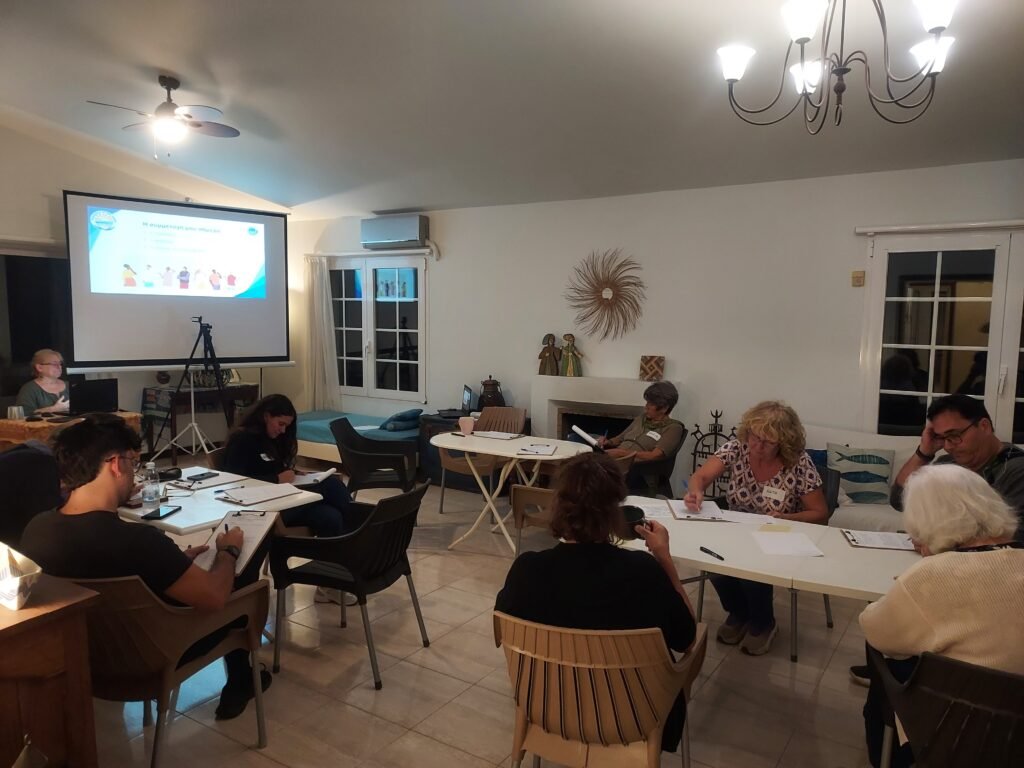
The session began with an experiential mapping of challenges faced by active citizens: limited time and resources, difficulty mobilising others, the gap between ideas and action, bureaucracy, the feeling that decision-makers are not listening, disagreement within groups, disappointment from previous experiences and the risk of taking on more than one can sustain.
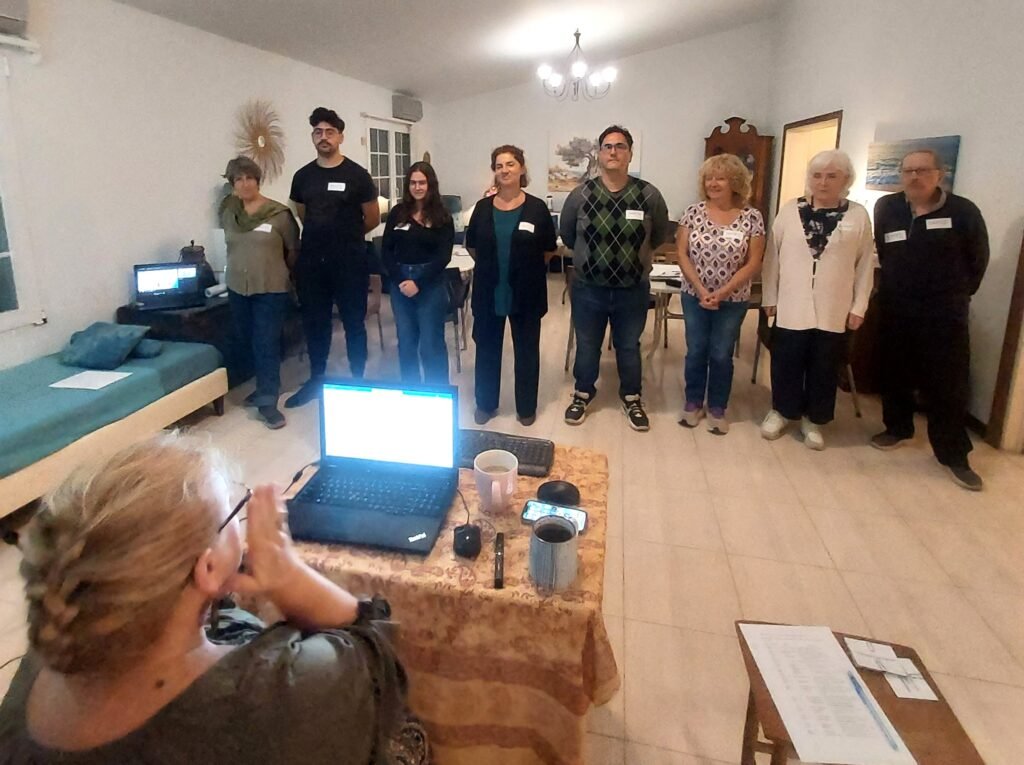
This led to the first role-play exercise, “A Group That Burns Out.” Participants enacted situations in which the same people repeatedly carry the workload, expectations exceed the group’s actual capacity, everything becomes urgent, disagreement escalates into conflict, or saying “no” is interpreted as a lack of commitment.
Only after experiencing these situations was the Thomas–Kilmann framework introduced as a simple map of different responses to conflict: competing, collaborating, compromising, avoiding and accommodating. The purpose was not to identify one universally “correct” response, but to recognise our habitual patterns and ask whether they are useful in a particular situation.
In the second round, “A Group That Remains Resilient,” the original problem remained. What changed was the availability of additional resources: clear boundaries, shared responsibility, small successes, recognition, mutual support, rest, joy, the right to say “no”, honest feedback, apology and repair.
This shift moved attention away from the idea of a “difficult person” and towards the culture and dynamics of the group itself.
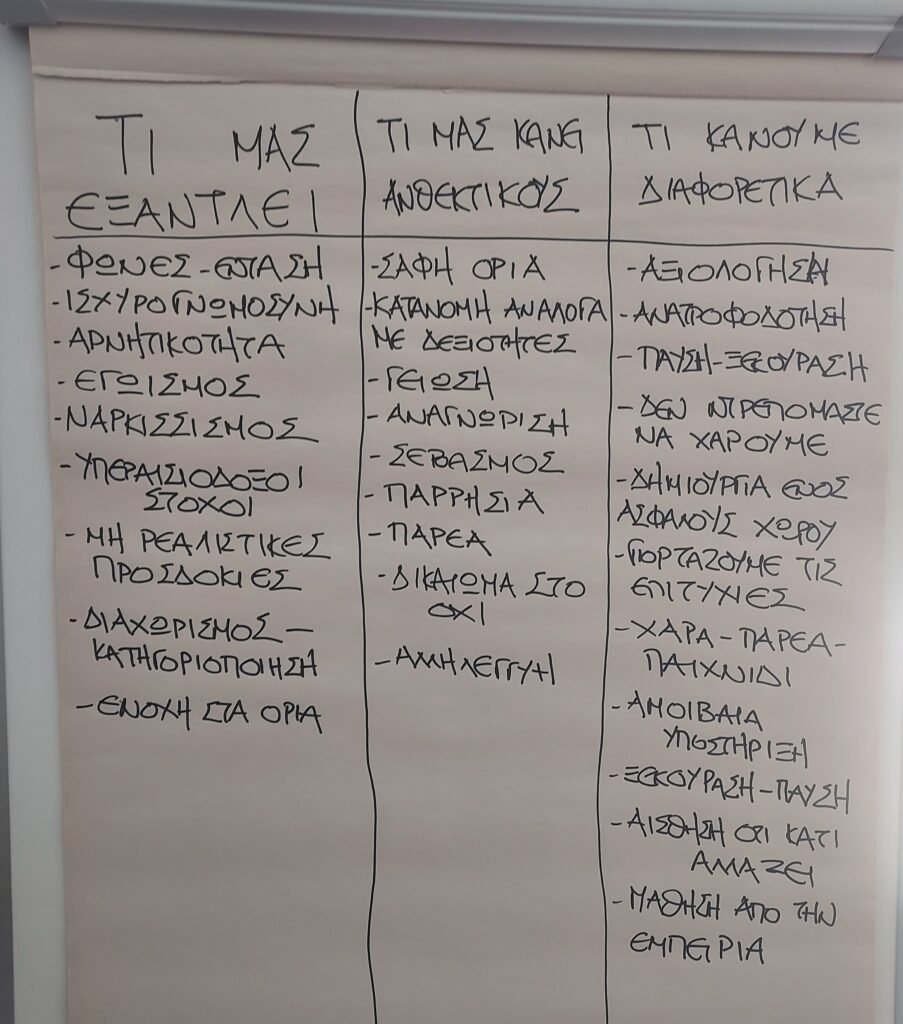
Participants then created a collective map around three questions: What exhausts us? What keeps us resilient? What can we do differently? Tension, rigidity, negativity, unrealistic expectations and guilt around boundaries were identified as draining factors. Clear boundaries, respect, frank communication, recognition, solidarity, shared responsibility and the right to say “no” emerged as protective factors. Evaluation, constructive feedback, rest, a safe group environment, joy, celebration of achievements and learning from experience were identified as practices that can make collective action more sustainable.
Particular attention was given to the distinction between healthy boundaries and walls, to the gradual building of trust through clarity and consistency, and to personal responsibility: we cannot expect others to guess our needs or change on our behalf.
Feedback was also explored as a learning tool rather than a judgement of character: specific, timely, focused on behaviour, respectful and intended to support improvement.
The final part of the workshop moved from large aspirations to achievable action. Through the worksheet “My Next Move,” participants connected an issue they genuinely care about with the main obstacle they face, a tool or approach they could use, a person with whom they could share it and one realistic action they could take within the following seven days.
The final evaluation produced an encouraging result. Of the nine short evaluation forms completed, eight respondents said that after the workshop they felt more capable of taking a next step towards collective action, while one felt about as capable as before. No respondent selected “less capable.”
The workshop closed around a central insight: Resilience is not only an individual capacity. It is also a characteristic of a group’s culture.
And with a principle that captures the spirit of the session: We do not only care for the issue we are fighting for. We also care for the people we are fighting alongside.
Our beaches. A common good. A shared responsibility. A common future.