14 October 2026 | Coastal protection begins with land use
Coastal conservation goes beyond removing litter or managing the beach itself. Decisions about development, green space and access to land behind the shoreline can affect biodiversity, coastal processes and community well-being. This wider perspective was the focus of the Greek Guardians of the Coasts team’s meeting with Verónica Santos, President of the General Assembly of Associação SOS Quinta dos Ingleses.
Quinta dos Ingleses and its coastal setting
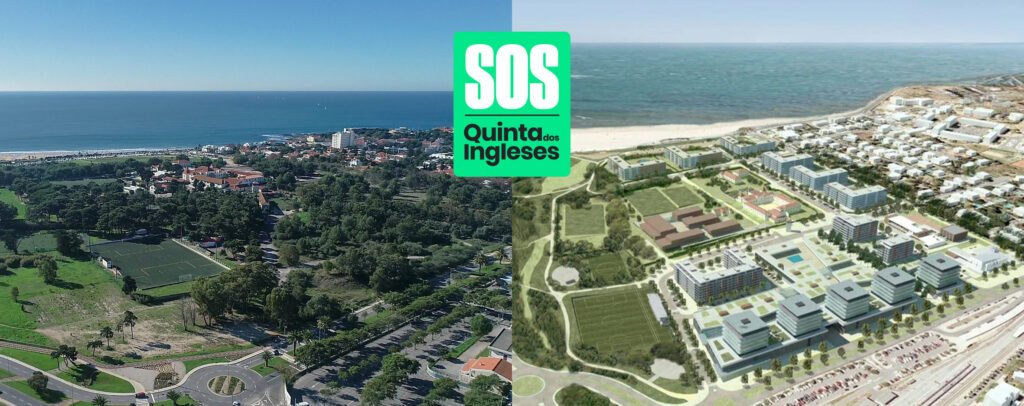
Quinta dos Ingleses lies near Carcavelos Beach and covers approximately 520 stremmata (52 hectares). It includes mature woodland, wildlife habitats and elements of cultural and historical heritage. Its importance to residents has also been social: for years, the area was used for walking, recreation and encounters with nature. The connection between this green space and the surrounding coastal landscape makes it particularly relevant to a project concerned with the protection of coasts.
Development and access
According to the association’s published material, the area is affected by plans for major residential and tourism development. SOS Quinta dos Ingleses opposes this approach, arguing that it would alter the site’s ecological and social role. In May 2024, the company Alves Ribeiro fenced off the area, curtailing residents’ previous access. This raised a fundamental question: how can a natural place with considerable community value remain meaningfully accessible?
The scale of the proposal, as described on the Portuguese-language SOS Quinta dos Ingleses website and in available planning material, includes up to 850 apartments, residential buildings of up to seven above-ground storeys and up to five basement levels, hotel accommodation and commercial premises. The association describes the site as approximately 52 hectares of green land, including 35 hectares of woodland. It argues that less than 10 hectares of public green space would remain: around two hectares beyond the road and around eight hectares also encompassing the stream bed, paths, recreation facilities and parking. These figures describe the association’s interpretation of the plan; they should not be mistaken for a separately verified measurement of planted public space.
Environmental and social concerns
Verónica Santos outlined the association’s concerns about potential consequences of the proposed development, including the loss of mature trees and habitats, pressure on local biodiversity and possible changes in microclimate and wind conditions that influence sand transport towards the beach. The discussion also covered potential increases in traffic, infrastructure pressures and reduced opportunities for recreation and social interaction in nature. These are the association’s concerns and projected risks; they are not presented here as independently established or already realised impacts.
From citizens’ movement to environmental association
The association was formed on 24 June 2021 following citizen mobilisation and nearly 9,000 objections recorded in an earlier public consultation, according to its website. It has held environmental NGO status since 1 October 2024. Its approach includes public information, petitions, consultation processes, dialogue with authorities and legal action. The evolution of this initiative is relevant to Guardians of the Coasts as a case study in active citizenship: turning community concerns into sustained, organised civic participation.
A public nature park as an alternative
Rather than only opposing a development project, SOS Quinta dos Ingleses proposes preserving the entire area as a substantial public urban nature park that protects ecosystems and heritage while serving the local community. This alternative connects ecological conservation, everyday public access and responsibility towards future generations.
Learning outcomes for Guardians of the Coasts
The meeting emphasised that: (a) protecting beaches requires considering the wider coastal landscape; (b) spatial planning decisions carry both environmental and social consequences; (c) meaningful access to natural space affects community life; and (d) citizen participation can combine research, dialogue, mobilisation and institutional procedures. The Quinta dos Ingleses case provides a useful basis for comparison with issues faced by coastal communities in Greece.
Our sincere thanks to Verónica Santos for this informative exchange and for sharing the association’s experience.
Sources and further information: en.sosquintadosingleses.com/associacao · en.sosquintadosingleses.com/perguntasfrequentes · en.sosquintadosingleses.com/paisagem
Source note: the association’s Portuguese-language website describes one hotel and buildings up to seven above-ground storeys, while its English-language version refers to three hotels and seven-to-nine-storey buildings. To avoid reproducing an unresolved inconsistency, this article refers generally to hotel accommodation and uses the Portuguese-language figures for the building heights. The developer’s website, in turn, describes an urban park, infrastructure and restoration works and states that the relevant approvals have been obtained. These are attributed positions of the parties concerned.
Sources: https://www.sosquintadosingleses.com/ ; https://www.sosquintadosingleses.com/perguntasfrequentes ; https://www.cascais.pt/anexo/consulta-publica-operacao-de-loteamento-da-quinta-dos-ingleses-1703-0704-decorrer-ate-4-de ; https://www.quintadosingleses.com.pt/
Our beaches. A common good. A shared responsibility. A common future.
Funded by the European Union. Views and opinions expressed are however those of the author(s) only and do not necessarily reflect those of the European Union or the State Scholarships Foundation (IKY). Neither the European Union nor the granting authority can be held responsible for them.